3kW vs 6kW vs 12kW Off-Grid Inverters: Which Size Fits Your Off-Grid Home or Farm?
Release time: 2026-06-11
Picking between a 3kW, 6kW, or 12kW off-grid inverter is rarely about brand preference — it’s a math problem disguised as a shopping decision. Get the size wrong, and a cabin owner ends up tripping breakers every time a fridge compressor kicks in, while a farm operator with an undersized unit watches a well pump stall mid-cycle. Get it right, and the system simply disappears into the background, doing its job for a decade without drama.
This guide breaks down what actually separates a 3kW unit from a 6kW or 12kW one — not just on paper, but in real load behavior, surge handling, and total cost of ownership.
What Actually Determines Off-Grid Inverter Size
Most buyers size an inverter by adding up appliance wattages and stopping there. That’s the first mistake. A correctly sized off-grid inverter has to account for:
- Continuous load — everything running at once (lights, fridge, electronics, pumps)
- Surge/startup load — the temporary spike when a compressor, motor, or AC unit starts
- PV input ceiling — how much solar array the built-in MPPT solar charger can actually absorb
- Future expansion — adding a workshop, a second fridge, or irrigation pumps later
Skipping the surge calculation is the single most common sizing failure in off-grid design. A 3kW continuous load with a 6kW startup spike will overwhelm an inverter rated only for steady-state output — even if the wattage “looks fine” on paper.
3kW vs 6kW vs 12kW: A Direct Comparison
Here’s how the three tiers actually stack up in real deployment scenarios:
| Spec | 3kW Class | 6kW Class | 12kW Class |
|---|---|---|---|
| Typical use case | Small cabin, RV, single-family weekend home | Mid-size off-grid house, small farm | Full off-grid residence, multi-building farm, light commercial |
| Continuous output | 3,000W | 6,000W | 12,000W |
| Surge capacity (2–3x) | Up to 9,000W | Up to 18,000W | Up to ~30,000W+ |
| MPPT PV input range | ~3,000W | ~6,000W | Up to 12,000W |
| Typical battery voltage | 24V/48V | 48V | 48V |
| Heavy loads supported | Small fridge, lights, laptop charging | Well pump, AC unit, kitchen appliances | Deep-well pump, multiple AC units, workshop tools, irrigation |
| Parallel/expansion potential | Limited | Moderate | High — designed for scaling |
The takeaway isn’t “bigger is always better.” A 12kW unit running a 3kW load wastes efficiency at low loads and adds unnecessary upfront cost. The goal is matching surge capacity to your worst-case startup event, not your average daily draw.
How Surge Capacity Changes the Sizing Equation
This is where most DIY sizing guides fall short. A well pump or air conditioner compressor can pull 2–3x its rated wattage for a few seconds on startup. If your surge capacity doesn’t cover that spike, the inverter shuts down protectively — even though your “average load” math said you had headroom.
Practical rule of thumb for 2026 off-grid installs:
- Identify your single largest motor-driven load
- Multiply its rated wattage by 2.5–3x for startup surge
- Confirm the inverter’s surge rating exceeds that number, not just its continuous rating
This is precisely why high-surge platforms — capable of 2-3x rated output for several seconds — exist as a separate spec line, not a marketing footnote.
Which Size Fits Your Home, Farm, or Light Commercial Site?
- 3kW class — Weekend cabins, tiny homes, vans with modest electronics and lighting loads. No heavy pumps or AC.
- 6kW class — Mid-size off-grid homes with a well pump, standard kitchen appliances, and at least one inductive-load appliance like an AC unit or chest freezer.
- 12kW class — Full-time off-grid residences, agricultural operations running irrigation pumps and equipment, or light commercial sites needing parallel-capable, expandable capacity.
If your load profile sits between tiers — say, a home that might add a workshop next year — sizing toward the higher tier with parallel expansion in mind is usually cheaper long-term than replacing an undersized unit.
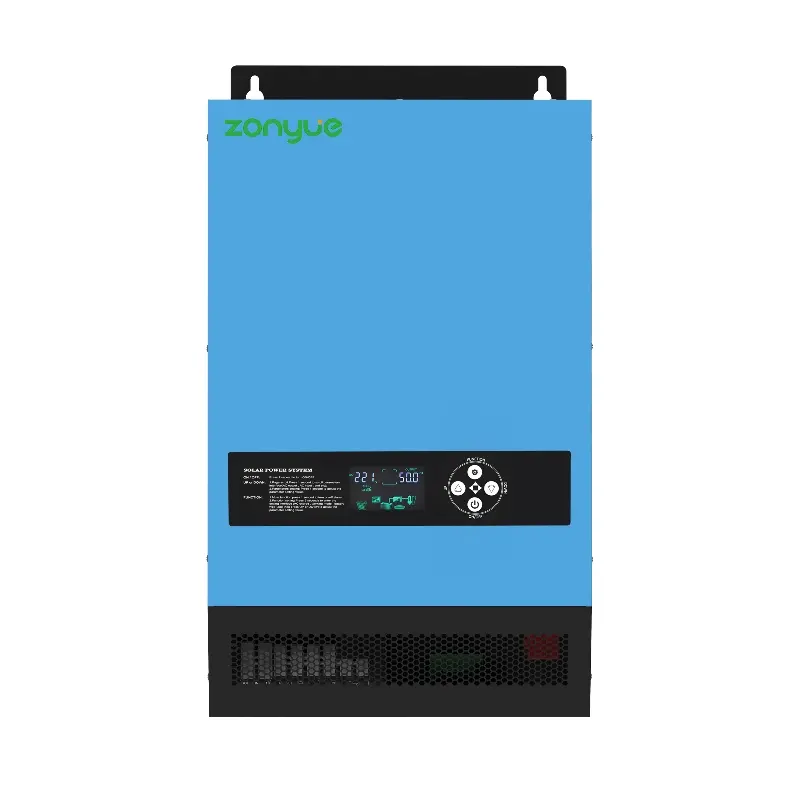
Choosing the right size also means choosing a platform built to handle PV variability and inductive startup loads without compromise. Zonyue’s off-grid inverter lineup spans the full 3–12kW range with 2–3x surge capacity, a high-efficiency MPPT solar charger rated up to 12,000W PV input, and pure sine wave output engineered for sensitive electronics and demanding motor loads alike. For distributors and brand owners evaluating a standalone power platform for OEM/ODM development, Zonyue’s engineering team can help match the right kW tier — and customize branding, enclosure, and firmware — to your target market’s real-world load profile.
FAQ
Q: What size off-grid inverter do I need for a typical home?
A: Most single-family off-grid homes with a well pump and standard appliances are well served by a 6kW unit with 2–3x surge capacity, assuming no heavy AC or workshop equipment.
Q: Can I just add solar panels later without upgrading the inverter?
A: Only up to the inverter’s MPPT input ceiling. Exceeding it causes clipping — your panels produce more than the inverter can use, wasting potential output.
Q: Is a 12kW inverter overkill for a small farm?
A: Not if you’re running irrigation pumps, multiple outbuildings, or workshop tools. The higher surge headroom prevents nuisance shutdowns during simultaneous motor startups.
Q: Does a bigger inverter waste more power at low loads?
A: Slightly — efficiency curves dip somewhat at very low load percentages. This is why matching size to actual surge and continuous demand matters more than simply “buying bigger for safety.”