Hybrid Inverter vs String Inverter: What C&I ESS Buyers Need to Know Before Choosing
Release time: 2026-06-24
For C&I project developers, the inverter choice often gets treated as a checkbox — pick whatever’s cheapest per watt and move on. That mindset breaks down fast once batteries enter the picture. A string inverter and a hybrid inverter look similar on a spec sheet, but they solve fundamentally different problems, and choosing wrong means re-engineering your storage architecture later at real cost.
This comparison isn’t about which technology is “better” in the abstract — it’s about which one actually fits a commercial or industrial site that needs storage, demand-charge management, or backup capability today or in the near future.
What Separates a Hybrid Inverter From a String Inverter
A string inverter does one job: convert DC from PV strings into AC for the grid. No battery port, no bidirectional charge/discharge control. It’s a clean, efficient, single-purpose device.
A hybrid inverter does considerably more:
- Manages PV input and battery charge/discharge in one unit
- Switches between grid-tied and backup operation without separate hardware
- Coordinates time-of-use arbitrage, peak shaving, and demand-charge reduction
- Communicates with BMS hardware across a wide voltage range for multi-brand battery flexibility
For a site with no storage plans, a string inverter is simpler and cheaper. For any C&I ESS project — which is most new commercial installs at this point — the hybrid inverter is the only architecture that avoids bolting a separate charge controller and battery inverter onto an already-installed string system later.
The Real Cost of Choosing Wrong
This is where the decision actually bites. Retrofitting storage onto a string-inverter-only site typically means:
- Adding a standalone battery inverter alongside the existing string inverter
- Running new DC/AC wiring and reconfiguring the switchgear
- Managing two separate monitoring and communication protocols instead of one
- Losing the efficiency advantage of a single conversion stage
A properly sized hybrid inverter avoids all four problems by design. It’s not just a “nice to have” — for sites planning demand-charge reduction or backup power within a 3-5 year horizon, retrofitting cost alone often exceeds the price premium of installing hybrid from day one.
Hybrid Inverter vs String Inverter: Side-by-Side
| Factor | String Inverter | Hybrid Inverter |
|---|---|---|
| Battery integration | None (requires add-on) | Built-in bidirectional charge/discharge |
| Backup power capability | No | Yes, with automatic transfer |
| Demand-charge management | Not supported natively | Native peak shaving / TOU arbitrage |
| Voltage range flexibility | Fixed PV-only range | Wide voltage (e.g., 160-800V), multi-battery-brand compatible |
| System complexity for ESS | High (two devices, two protocols) | Low (single integrated platform) |
| Typical efficiency (with storage) | Lower (stacked conversion losses) | Up to 98.2% peak, >97.5% European efficiency |
| Best fit | Grid-tied-only sites, no storage plans | Any C&I ESS site, current or planned |
Where the High-Voltage Hybrid Inverter Advantage Really Shows Up
Not all hybrid inverters are built the same. The technical differentiator that matters most for C&I buyers is voltage range. A narrow-range unit forces you into a specific battery chemistry or brand, which becomes a procurement constraint the moment your preferred supplier changes pricing or lead time.
A wide voltage range hybrid inverter spanning roughly 160-800V solves this by:
- Supporting multiple lithium battery types without re-engineering the DC bus
- Reducing current at higher voltage, which means thinner cabling and lower I²R losses
- Allowing 2-6 independent MPPT trackers to handle complex multi-orientation rooftop layouts without sacrificing harvest
- Keeping procurement flexible as battery markets and pricing shift year to year
This is precisely why 800V architecture has become the focal point of 2026 hybrid inverter discussions — it’s not a marketing spec, it’s a procurement hedge.
Which One Should a C&I Buyer Actually Choose?
- Choose a string inverter only if the site has zero storage plans, no backup requirement, and no demand-charge exposure — increasingly rare for new commercial builds.
- Choose a hybrid inverter if storage is installed now, planned within a few years, or backup power and TOU arbitrage matter to the site’s economics. For most C&I ESS buyers evaluating 2026 projects, this is the default answer.
The decision ultimately comes down to whether you’re building for today’s grid-tied load or for a site that will eventually need storage-driven cost control. Betting on the latter — and being wrong — is far cheaper than betting on the former and being wrong.
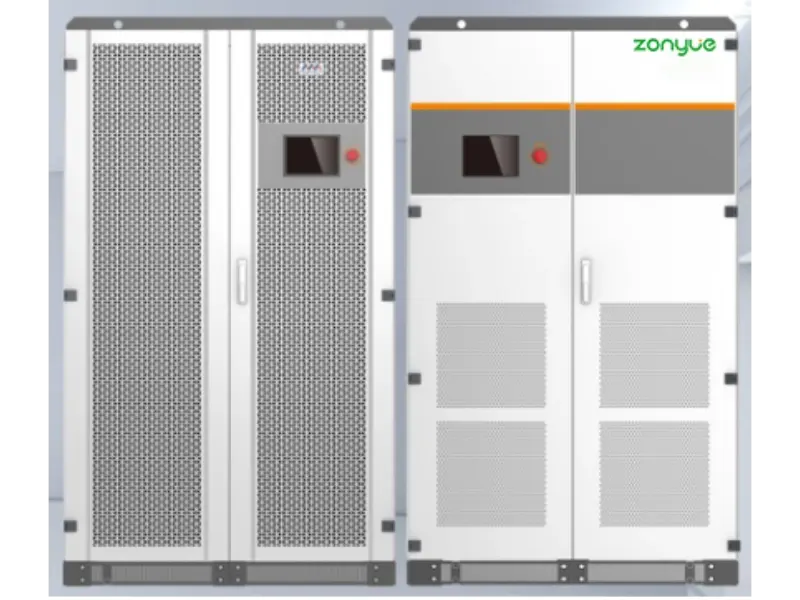
For developers and OEM/ODM partners evaluating a high-voltage hybrid inverter platform, Zonyue’s lineup spans residential 5-16kW models through C&I systems rated up to 500kW, all engineered around the same 800V wide-voltage architecture and 98.2% peak efficiency. Our technical team can help match the right model — or build a fully branded version — to your project’s battery chemistry, load profile, and grid requirements.
FAQ
Q: Can a string inverter be converted into a hybrid inverter later?
A: Not directly. You’d need to add a separate battery inverter and reconfigure wiring and monitoring — effectively running two systems in parallel rather than one integrated unit.
Q: Does a hybrid inverter cost more than a string inverter upfront?
A: Generally yes, due to the added battery management and bidirectional conversion hardware. But for any site planning storage, the upfront premium is typically lower than retrofitting later.
Q: Why does voltage range matter when choosing a hybrid inverter for C&I storage?
A: A wider voltage range (e.g., 160-800V) supports more battery brands and chemistries, reduces current-related losses, and protects you from being locked into a single battery supplier.
Q: Is a hybrid inverter necessary if I only need backup power, not daily cycling?
A: Yes — backup power requires bidirectional charge/discharge and automatic transfer capability, both of which are native to hybrid inverters but absent in string-only systems.